
5 “AI Tells” That Make Your Blog Content Sound Fake (& How to Fix Them)

Artificial intelligence is a powerful co-writer. It can draft outlines, summarize research, and turn a blank page into a full article in minutes.
But there’s a problem. Most AI-generated content sounds…well, robotic. It’s often generic, bland, and filled with phrases that scream “a machine wrote this.”
So, how do you write blog content that leverages the speed of AI without sacrificing the authenticity that builds trust with your readers?
The answer is in effective AI editing. You need to learn how to spot the “AI tells” – the dead giveaways that your content came from a machine – and transform them. Your goal is to shift from being just a writer to becoming a skilled director, guiding the AI and then adding the human touch that makes your content unique.
This post will show you five common AI tells and give you practical steps to fix them, so your content connects with readers and drives results.

1. The Cliché Storm
AI models learn from a vast dataset of internet text, which means they love to use overused, tired phrases. Does your draft start with “In today’s fast-paced digital world,” “In the realm of,” or end with “In conclusion…”? If so, you’ve been hit by a cliché storm.
These phrases are filler. They add no value and make your writing feel generic. A human writer with a unique perspective wouldn’t rely on them, and neither should you.
HOW TO FIX IT
Be ruthless. Your first step in AI editing is to search for and destroy these clichés.
▷ Cut the Fluff: Read your introduction. Does it get straight to the point, or does it waffle with generic statements? Cut the opening sentence and see if the paragraph is stronger. It usually is.
▷ Be Specific: Instead of “The digital landscape is ever-evolving,” try something more direct like, “Your customers find you on TikTok and Google, not the Yellow Pages.” Specificity adds personality.
▷ End with Action: Replace “In conclusion” with a powerful final thought or a direct question to your reader. Guide them toward what they should do or think about next.
2. The Lack of “You”
AI doesn’t have a personal life. It has never failed at a product launch, celebrated a client’s success, or learned a hard lesson from experience. Because of this, its writing is often sterile and lacks personal stories, opinions, and anecdotes.
This is a huge problem. Stories are how we connect. Opinions are what build authority and create a tribe of followers. If your content is just a collection of facts without any personal flavor, it won’t be memorable. People don’t follow brands that sound like encyclopedias.
HOW TO FIX IT
This is where you, the human, are irreplaceable. Your unique experiences are your greatest asset.
▷ Add Personal Anecdotes: Where can you add a short, relevant story? Start a sentence with “I remember when…” or “I once had a client who…” This simple trick instantly makes your content more relatable and trustworthy.
▷ State Your Opinion: Don’t be afraid to take a stand. An AI will say, “Some marketers prefer strategy A, while others prefer strategy B.” You should say, “Forget strategy B. I’ve found that strategy A delivers better results every time, and here’s why.” A strong point of view is magnetic.
▷ Use Your Voice: How would you explain this topic to a friend over coffee? Read your draft out loud. If it sounds like a textbook, rewrite those sections in your own words. Use your own analogies and phrasing.
3. The Predictable Sentence Structure
Another classic AI tell is a monotonous rhythm. AI tends to write sentences that are all roughly the same length and follow the same basic structure (e.g., Subject-Verb-Object). This makes the content feel flat and can quickly bore your reader.
Good writing has a natural cadence. It flows. It uses a mix of short, punchy sentences and longer, more descriptive ones to create a dynamic reading experience that holds attention.
HOW TO FIX IT
Become a sentence musician. The goal of your AI editing here is to vary the rhythm.
▷ Mix It Up: Intentionally write a very short sentence. Then, follow it with a longer, more complex one. This contrast creates a powerful effect. It grabs the reader. It makes your points land with more impact.
▷ Start Sentences Differently: Scan your paragraphs. Do too many sentences start the same way? Try starting with a preposition (“In our experience…”), a transition word (“However…”), or a dependent clause (“Although it seems simple…”).
▷ Read It Aloud: This is the ultimate test. If you find yourself reading in a monotone voice, your sentence structure is too repetitive. If you stumble over a sentence, it’s probably too complex. Rewrite those parts until they flow smoothly off the tongue.
4. The Overly Formal Tone
AI models often default to a formal, almost academic tone. They use words like “utilize” instead of “use,” “therefore” instead of “so,” and “in order to” instead of just “to.” While this might be appropriate for a scientific paper, it creates a wall between you and your reader in a blog post.
You want your writing to feel like a conversation, not a lecture. A conversational tone is more engaging, builds rapport, and makes your content more accessible.
HOW TO FIX IT
Translate the “robot-speak” into human-speak.
▷ Choose Simpler Words: Go through your draft and replace complex words with simpler alternatives. Write for clarity, not to impress a vocabulary teacher.
▷ Use Contractions: Use “you’re,” “it’s,” and “don’t.” Contractions are a hallmark of conversational language.
▷ Ask Questions: Engage your reader directly by asking them questions. “Have you ever felt that way?” or “What would you do in this situation?” This pulls them into the conversation.
5. The Vague & Non-Committal Language
Because AI doesn’t have true expertise or experience, it hedges. It uses cautious and vague phrases like “it seems that,” “it could be argued,” or “this may lead to.” This type of language weakens your message and undermines your authority.
Your readers are looking for answers and confident guidance. If your content is wishy-washy, they’ll click away and find a source that provides clear, actionable advice.
HOW TO FIX IT
Write with conviction. Your AI editing pass should focus on making every statement clear and confident.
▷ Remove Hedging Words: Search for words like “might,” “could,” “perhaps,” and “seems.” In most cases, you can delete them to make your sentence stronger.
▷ Provide Concrete Examples: Instead of saying “This strategy may lead to better results,” provide proof. Say, “This strategy led to a 50% increase in leads for our client, [Client Name].” Data and specific examples build trust.
▷ Own Your Expertise: You are the expert, not the AI. Write like it. Replace “It is important to…” with “You need to…” Take command and guide your reader with confidence.
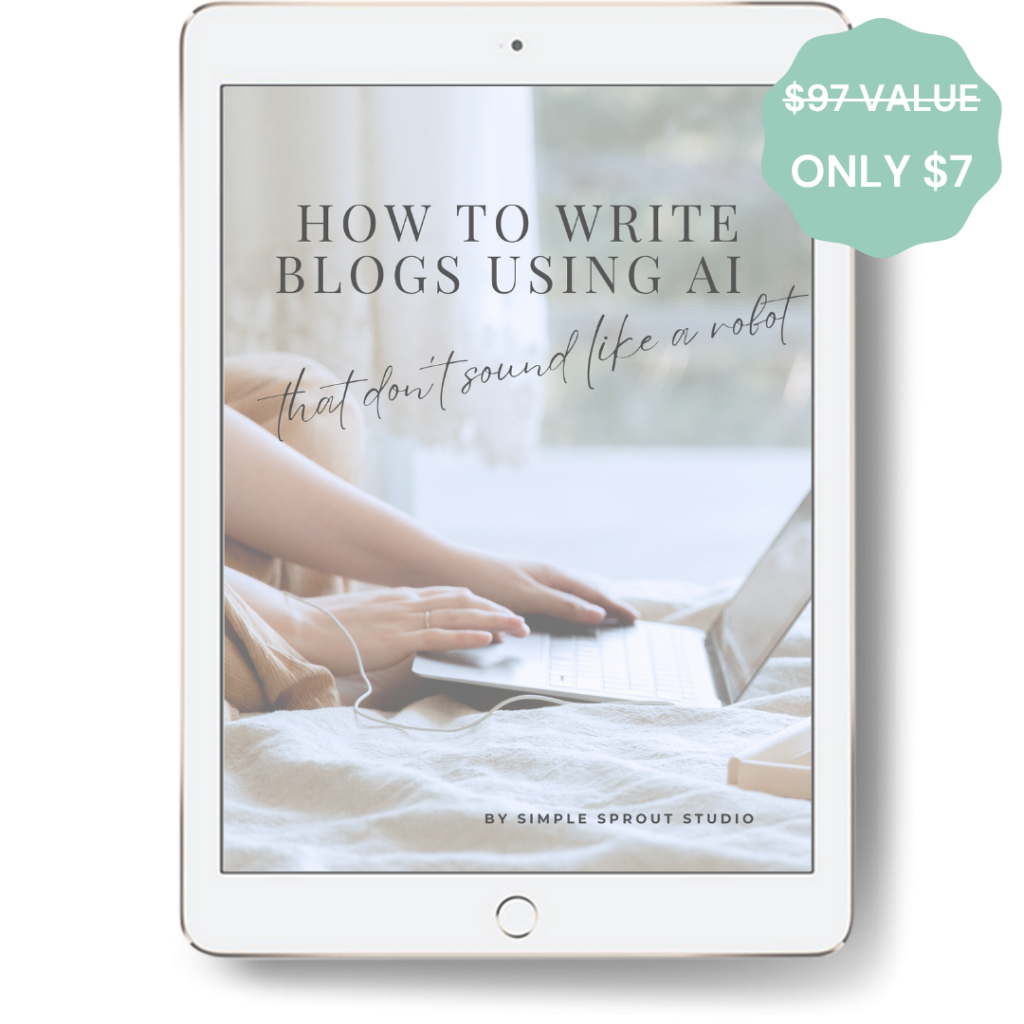
Stop sounding like a robot. Download the guide now for just $7.
Want the complete checklist to help you? My “Humanizer” Checklist is part of the “How to Write Blogs Using AI (That Don’t Sound Like a Robot)” guide. It gives you the exact framework for turning robotic drafts into remarkable content.
Learning how to write blog content with AI is a two-part process. The first is generating the draft; the second, and most important, is the human touch you apply through AI editing.
By spotting and fixing these five AI tells, you can transform a generic, robotic draft into a powerful, authentic piece of content that builds your brand and connects with your audience. It’s the key to using AI as a tool to become a faster, more effective writer, not a replacement for one.
ready for more?
We’ve got you covered…and we’ll keep it simple.
Every week, we’ll pop in your inbox with awesome SEO and blogging tips made easy.