
The SEO Mistakes Most People Make with AI Blog Writing

You’ve used AI to help write your blog. Smart move.
But here’s the thing: if the result sounds off – formal, awkward, repetitive, distant – it might be time for a tune-up. Because at the end of the day, your readers don’t want an algorithm speaking at them. They want someone speaking with them.
So: here are five tell-tale signs your AI-generated blog is giving off robot vibes – plus how to bring it back to human.

1. It’s overly formal or robotic in tone
The sign: Every sentence starts with “Additionally,” or “Moreover,” or “In this context.” It uses big words, long clauses, passive voice – almost like a corporate report rather than a blog written by someone talking to you.
Why it happens: AI tends to lean safe. It picks words that are “correct” in a general sense, which often means more formal language and conventional phrasing.
How to fix it:
▹ Rewrite key sentences so you’d say them in a conversation: “Here’s something you’ll want to know…” instead of “It is of importance that you understand…”
▹ Mix sentence lengths – throw in short, snappy ones: “This is the point. Then we’ll dig in.”
▹ Use contractions and informal touches: “you’ll,” “want to,” “it’s okay if…”
▹ Read the piece out loud. If you sound like you’re explaining to someone over coffee, you’re moving in the right direction.
2. It repeats phrases, ideas, or sentence structures
The sign: You’ll catch the same phrase used two or three times, or the structure of paragraphs feels the same: definition, impact, solution — rinse and repeat. It becomes predictable.
Why it happens: AI models often fall back on “safe” patterns because they’ve seen them lots in data. While that’s fine for structure, it can get stale and robotic.
How to fix it:
▹ Break the pattern: if you’ve done definition–impact–solution three times, switch it up. Maybe start with a story, ask a question first, or flip the structure.
▹ Use synonyms and varied phrasing. But go further: use different sentence lengths and rhythms.
▹ Insert a quick anecdote or concrete example. That disrupts the pattern and brings in human texture.
▹ Scan for repetition. If you used “as a result” more than twice in the first three paragraphs, consider swapping in “so,” “that means,” or “which leads to.”
3. It lacks personal voice, story, or emotional connection
The sign: You don’t sense a “who” behind the words. The blog feels like an instruction manual or textbook. No “I,” no “you,” no sense of someone who’s been there, made mistakes, had an insight.
Why it happens: AI can supply factual value or logical content, but it doesn’t spontaneously have your journey or lived experience. Without your touch, it stays generic.
How to fix it:
▹ Add a short personal aside: “I’ve made this mistake,” or “One time I tried X and learned Y.”
▹ Use direct address: talk to “you” and reference the reader’s situation. “If you’ve ever stared at a blinking cursor and felt stuck…”
▹ Tie in a little emotion or reaction: “That pang of doubt,” “the relief I felt when,” etc. Humans feel that. Robots don’t.
▹ Use “we” or “I” consciously (depending on your brand voice) so that someone’s behind the text. Even a single “I remember…” moment can humanize things.
4. It uses vague generalities rather than concrete examples
The sign: Phrases like “many businesses,” “a number of users,” “this solution is effective” without any specifics. You might think, “Which businesses? What users? How effective?” The claims feel untethered.
Why it happens: AI often maintains safe ambiguity – better not to be wrong than to pinpoint something that may be inaccurate. But the trade-off is blandness.
How to fix it:
▹ Add concrete details: “Last quarter our blog traffic rose 28%.” Or: “One client emailed me after implementing this tip and said…”
▹ Use numbers, dates, “one day I…” or “in the summer of 2024…” to anchor intangible claims.
▹ Whenever you make a claim, ask yourself, “Could someone ask ‘How so?’” If yes, then add the “how.”
▹ Even if you don’t have hard numbers, you can pick a specific scenario: “Imagine you’re drafting a 1,500-word post with zero distinct narrative…” That wins over “many writers.”
5. It lacks varied rhythm or natural readability
The sign: You feel the blog reads like it’s been generated. Long paragraphs, every sentence similarly structured, little variation. Maybe some weird phrasing: “The writer can optimize content” instead of “You can optimize your content.” It lacks the “flow” humans have.
Why it happens: AI tends to produce polished – but uniform – output. Without human editing, you miss the natural ups and downs of real writing: short punchy lines, conversational questions, asides, rhythm.
How to fix it:
▹ Vary paragraph length; include one- or two-sentence paragraphs for emphasis.
▹ Ask a question mid-post: “Have you ever felt like that?” That makes the reader pause and respond.
▹ Insert “pause” words or phrases: “So,” “Now,” “Here’s the thing,” “But wait.” These break the smooth but flat stream of text.
▹ Use more active voice: “You’ll see” rather than “It will be seen.”
▹ After draft: read as though you’re meeting someone for coffee and explaining your point. If it sounds natural when spoken, you’re doing pretty well.
Putting it all together
When you finish your AI-assisted draft, run a quick “humanity check.” Ask:
▹ Does this sound like me speaking?
▹ Could I say this to a friend or a peer?
▹ Is there at least one concrete story, detail, or insight here?
▹ Do the sentences flow with variation and personality?
▹ If this were offline and handed out on paper, would someone mark it: “A bit stiff”? If yes , let’s loosen it.
Remember: The tech is a helper. It’s a tool, not the author. You are the author. Your tone, your experience, and your voice matter more than perfectly polished “correct” sentences. Your readers are looking for a human connection, not flawless algorithmic prose.
When you lean into your voice, your quirks, your lived experience, your unique phrasing – that’s when the blog stops sounding like a robot and starts sounding like you.
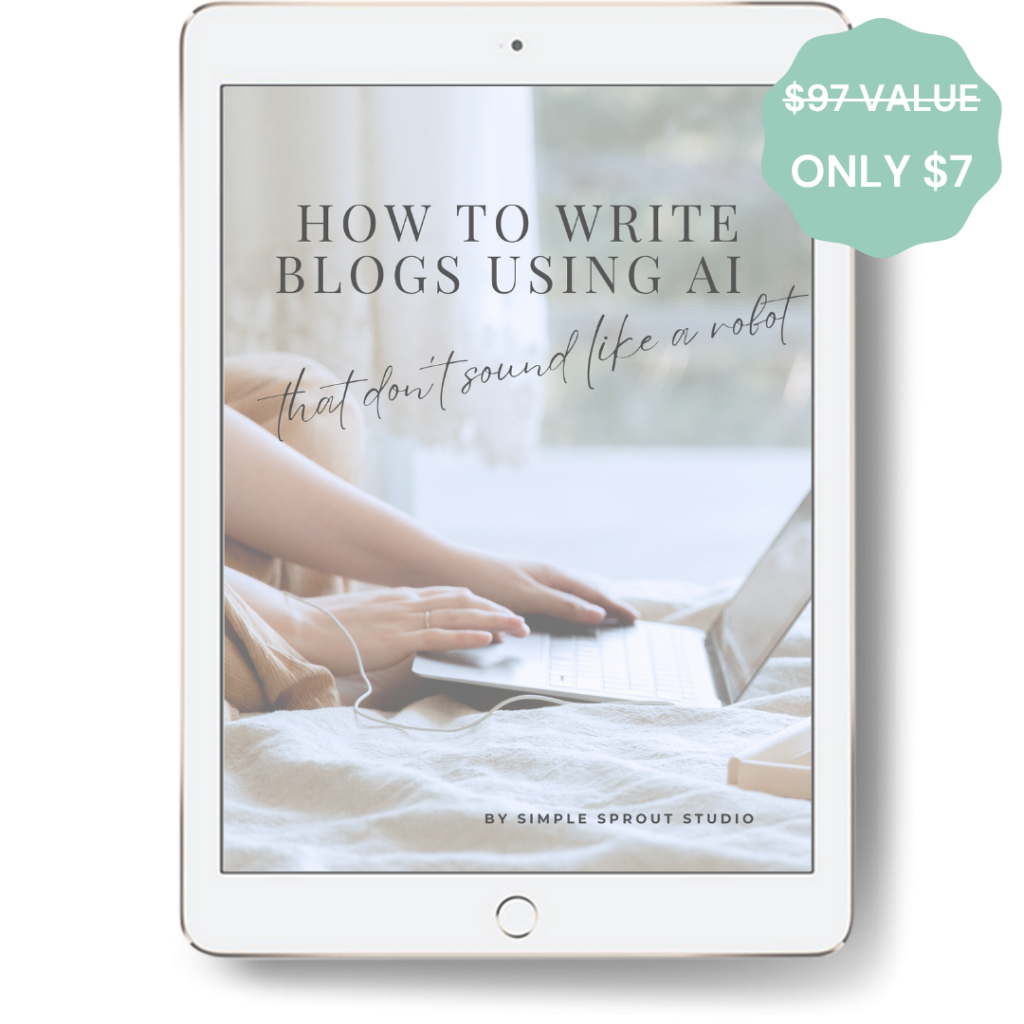
Ready to say goodbye to boring, robotic blogposts?
Grab this $7 guide and discover how to use AI to write content that feels real – and actually gets results.
Inside, you’ll get the four-phase blueprint for turning ideas into stand-out posts, plus plug-and-play prompts that take the guesswork out of getting started. Take control of your blog, wow your readers, and start seeing real growth…one genuinely helpful post at a time.
So next time you hit “Generate,” and you spot those signs the blog’s sounding robotic, don’t panic. It’s fixable. Grab your draft, pick one of the five signs we covered, and do a human-first edit. Make it yours. Make it real. Make it conversational.
After all, blogs aren’t about perfection. They’re about connection. They’re about someone real speaking to someone else real. And when you nail that — well, that’s when the magic happens.
Here’s to writing that sounds just like you!
ready for more?
We’ve got you covered…and we’ll keep it simple.
Every week, we’ll pop in your inbox with awesome SEO and blogging tips made easy.